
Why We Took a Global Poverty Charity Offline to Raise $398,320 in Recurring Donations at The Bizarre Agency
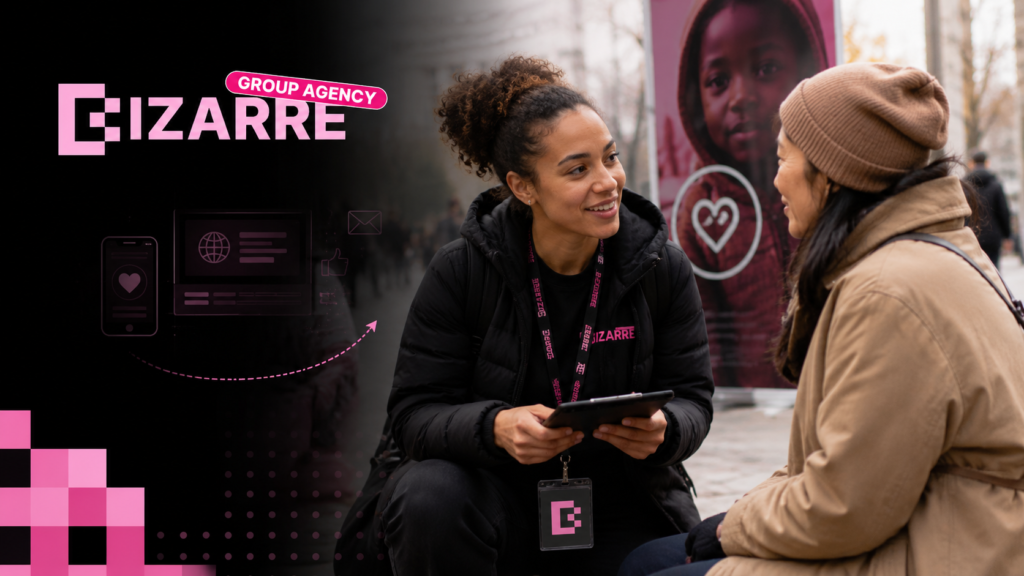
This is the story of how we helped them fix that, and how a single shift in strategy turned a leaky donor pipeline into $398,320 in generated revenue.
The Challenge: A Funding Model Built on One-Time Goodwill
The trouble is what happens after that first donation, or more accurately, what doesn’t happen.
The organization found that its digital donors were overwhelmingly one-time givers. Someone might see an emotive ad about a family displaced by conflict, feel moved, and give twenty or fifty pounds on the spot. That gift matters. But it’s a transaction, not a relationship. Once the ad stopped appearing in someone’s feed, so did their connection to the cause. Very few of these supporters converted into repeat donors, and fewer still signed up for any kind of recurring gift.
That created a difficult economic reality. The cost of acquiring each donor through digital channels was high relative to the value that donor would actually deliver over time. When most of your donors give once and disappear, you’re constantly running to replace them just to stand still, let alone grow the programs that depend on that funding. Digital ads are also, by nature, a one-way conversation. A donor can watch a video or read a paragraph of copy, but they can’t ask a question, hear a real story from someone who has seen the impact firsthand, or feel the weight of a genuine human exchange. That limited personal connection was quietly capping both emotional buy-in and long-term giving behavior.
The organization didn’t have a generosity problem. It had a connection problem.
The Solution: Trading Screens for Conversations
We shifted the campaign away from digital acquisition and towards direct, face-to-face donor engagement. This meant putting trained fundraisers in front of real people, in real conversations, where the organization’s mission and impact could be communicated properly rather than compressed into a six seconds skippable clip.
There’s a reason face-to-face fundraising consistently outperforms digital-only strategies for causes like this one: nuance. A conversation allows a fundraiser to read the person in front of them, answer their specific questions, address hesitations in real time, and share the kind of detail that builds genuine trust. It’s the difference between being told a story and having a story told to you by someone who clearly believes it. That distinction matters enormously when you’re asking someone to commit not just a one-off gift, but an ongoing part of their monthly budget.
Which was the second, and arguably more important, shift in strategy. Rather than optimizing for one-time donations the way the previous digital campaigns had, we focused the entire engagement model on converting interest into recurring monthly gifts. Every conversation was designed with retention in mind from the outset, not as an afterthought once someone had already given once.
This is a fundamentally different way of thinking about fundraising. A one-time gift solves today’s problem. A recurring donor solves this year’s problem, and quite possibly next year’s too. By prioritizing the ask that actually matched the organization’s long-term needs, we weren’t just changing the channel; we were changing what success looked like.
The result was a donor base built on ongoing relationships rather than a string of disconnected transactions. Instead of chasing a constant stream of new, unfamiliar faces through a newsfeed, the organization started building a community of supporters who understood the cause, had spoken to a real person about it, and had made a considered, personal decision to keep giving.
The Result: $398,320 and a Sturdier Foundation
That distinction is everything in the non-profit world. A pound raised from a one-time digital donor and a pound raised from a recurring monthly donor might look identical on a balance sheet today. Still, they behave very differently over a twelve-month horizon.
Recurring donors provide predictable income that organizations can actually plan programs around, rather than reactive income that arrives in unpredictable bursts.
What This Means for Other Non-Profits
If your organization is seeing plenty of one-time gifts but struggling with retention, it might be worth asking the same question we asked here: are your supporters being asked to feel something briefly, or are they being given the chance actually to connect with your mission? Face-to-face engagement isn’t the right fit for every campaign or every budget. Still, where it is viable, it remains one of the most effective ways to convert passive interest into sustained, recurring support that lets non-profits plan beyond next quarter.
At Bizarre, this is the work we specialize in: building fundraising and engagement strategies for human rights and non-profit organizations that need more than a click; they need a lasting relationship with the people who believe in their cause.
This campaign sits alongside other work we’ve done across the human rights and non-profit sector, from medical aid fundraising to campaigns tackling gender inequality. Different causes, different audiences, but the same underlying pattern shows up again and again: organizations that measure success purely by how many people clicked or how many gifts came in this month often overlook the slower, harder-won metric that actually sustains them: trust. Trust doesn’t scale the way an ad impression does. It has to be built one conversation, one honest answer, one follow-through at a time. That’s precisely why face-to-face engagement, while more resource-intensive to run than a digital campaign, tends to pay back its investment many times over across the lifetime of a donor relationship.
It’s also worth saying that this isn’t an argument for abandoning digital fundraising altogether. The two approaches serve different purposes, and the strongest fundraising strategies we build for clients tend to use digital channels to build initial awareness and reach, while reserving face-to-face engagement for the moments that actually need to convert curiosity into commitment. Knowing which channel to use, and when, is often the difference between a campaign that generates noise and one that generates $398,320 in durable, recurring income.
If your organization is facing similar challenges with donor retention or acquisition costs, we’d love to discuss what a face-to-face strategy could look like for you. Get in touch with our team to start the conversation.